People didn't know how to stay safe online, or where to turn when they weren't.
Jurisio is a cybersecurity app that combines education, incident reporting and real-time updates, in collaboration with government and educational bodies. It helps people learn to stay safe online, and report cyber incidents quickly when something goes wrong.
The problem
Low cybersecurity knowledge, and no efficient way to report an incident promptly.
My role
Solo, over three months: research, user flows, information architecture, wireframes and visual design.
The result
A friendly mobile app for learning, reporting, staying updated and getting help.
How I worked
01 · Discover: research, competitors
02 · Define: personas, empathy map
03 · Ideate: user flow, card sorting, IA
04 · Design: wireframes, visual design
01 · Who it's for
Designed for people who feel online threats, but can't name them.
General internet users with very different levels of knowledge. From interviews and the survey, two profiles stood out.
User profile · 01Entrepreneur
Name
Lisa Maria
Age
29
Struggles
Keeping up with threats and best practices; overwhelmed by news of breaches and scams
Wants
To feel confident online, and know how to protect her personal information
Pain
Can't tell legitimate from malicious activity, and worries about her data
“I wish there was an easy way to learn about cybersecurity.”
“There should be an easier way to report cyber incidents.” — Teller Harris, 27, solopreneur
Profiles built from 10 interviews and 50 survey responses.
See the empathy map
Perspective
Low cybersecurity knowledge
Struggles to report incidents
Says
“I don't know where to go for reliable information on staying safe online.” “I need a solution that doesn't feel intimidating.”
“I need a quick and efficient platform to submit complaints.” “I want to feel confident my report is taken seriously.”
Thinks
Cybersecurity seems too complex and technical. I worry about my personal information online.
I'm not sure where to report cyber incidents. Will my complaint even make a difference?
Does
Avoids some online activities out of fear, and looks for beginner-friendly resources.
Delays reporting because the process seems complex, and searches for easier platforms.
Feels
Frustrated by the lack of clarity, anxious about threats, overwhelmed by information.
Frustrated by the lack of a streamlined process, and unsure a single report has any impact.
What they open the app to do
Learn
Understand threats like phishing, malware and online fraud, without the jargon.
Report
File a complaint quickly, attach evidence, and track what happens next.
Stay updated
Get local threat alerts and cybersecurity news as it happens.
02 · The numbers
The numbers told me where to look.
I combined one-to-one interviews with an online survey, then tested three competitors from a user's point of view.
10People interviewed
50Survey responses
3Competitors tested
3Months
The questions that shaped the design
Which features would be most valuable in an app like Jurisio?
Educational content and training34%
Easy-to-use e-complaint filing28%
Real-time threat alerts20%
Privacy setting recommendations18%
Which security actions do you wish were easier?
Setting up two-factor authentication36%
Changing passwords regularly22%
Reporting suspicious activity22%
Configuring privacy settings20%
Which format is most effective for cybersecurity education?
Live webinars or workshops34%
Infographics and visual content28%
Interactive videos/tutorials20%
Written articles and guides18%
Have you ever been a victim of a cyberattack or data breach?
No74%
Yes26%
See the other survey questions and interview script
How often do you rely on these sources for security news?
Security software alerts20%
News websites20%
Social media20%
Online forums or communities20%
Email alerts from trusted sources20%
How often do you engage with security training?
Weekly30%
Monthly20%
Rarely20%
Never20%
Daily10%
How often do you share security tips with friends or family?
Often44%
Occasionally28%
Rarely20%
Never8%
How often do you join security webinars or workshops?
Frequently42%
Occasionally28%
Rarely24%
Never6%
Interview questions
How aware are you of cybersecurity threats and how to protect yourself online?
What gets in the way when you try to report a cyber incident or file a complaint?
How do you stay informed about cybersecurity, and do those sources work for you?
Describe a time you felt vulnerable to a cyber threat. What did you do?
What support or information do you feel is missing for your own security?
What would you expect from an app that helps with cybersecurity?
03 · What I found
People wanted to learn and to report. Without the jargon.
SurveyWhat people saidSo the design
34%rated educational content the most valuable featureMakes Education the first feature on Home
28%wanted easy e-complaint filing mostGives reporting a short form with attachments and tracking
26%had already been a victim of an attack or breachKeeps “report an incident” one tap from Home
28%learn best from infographics and visual contentUses illustrations and visual cards over long text
The interviews added one more thing: people felt overwhelmed by technical jargon, and wanted clear, accessible content.
So the brief wrote itself
How might we make cybersecurity feel approachable, and reporting an incident feel simple, for people who've never done it before?
04 · The problems
Four problems, pinned down.
Each one came up in the interviews and the survey. Tap a card to see what it meant for the design.
05 · Studying the field
Three apps. None did it all.
I used Ai Cybercrime, Cyber Alert and Vakil Search as a user would, and compared positive and negative reviews on the App Store and Play Store.
Ai Cybercrime
Good
Uses AI against cybercrime, with good customer satisfaction.
Challenging
Irregular updates, slow responses, and it doesn't cover every type of threat.
Cyber Alert
Good
Builds awareness, offers legal advice, and groups complaints to help investigators.
Challenging
Hard-to-use design and navigation, and real-time updates aren't a priority.
Vakil Search
Good
Wide legal services, a friendly interface and transparent pricing.
Challenging
Focused on specific legal services, not complex issues or education.
What they do well
Each solves one piece: awareness, legal help or complaint handling.
The gap
None combines easy learning, simple reporting and live updates in one approachable app. That's where Jurisio fits.
Where that left the product
Intent
A premier cybersecurity app for education, reporting and collaboration with government and educational bodies.
Success means
Engagement & education
Complaint resolution
Timely updates
How it makes money
Freemium: essentials free, in-depth courses by subscription, plus security partnerships and targeted ads.
06 · Shaping the structure
Six journeys, three tabs.
I mapped the journey first: launch, sign up or continue as a guest, then the main dashboard. Card sorting grouped every feature, and I refined the result so the most important things are the easiest to find.
Education
Learning paths
Simulations
Progress tracking
Achievements
Community
Discussion groups
Challenges
Forums
FAQs
Report incidents
Streamlined form
Incident tracking
Attach files
Real-time updates
Local threat alerts
Custom notifications
Security news
Profile
Profile information
Premium pack
Log out
Settings
Notifications
Security
About app
Feedback
07 · Wireframes
Layout first, colour later.
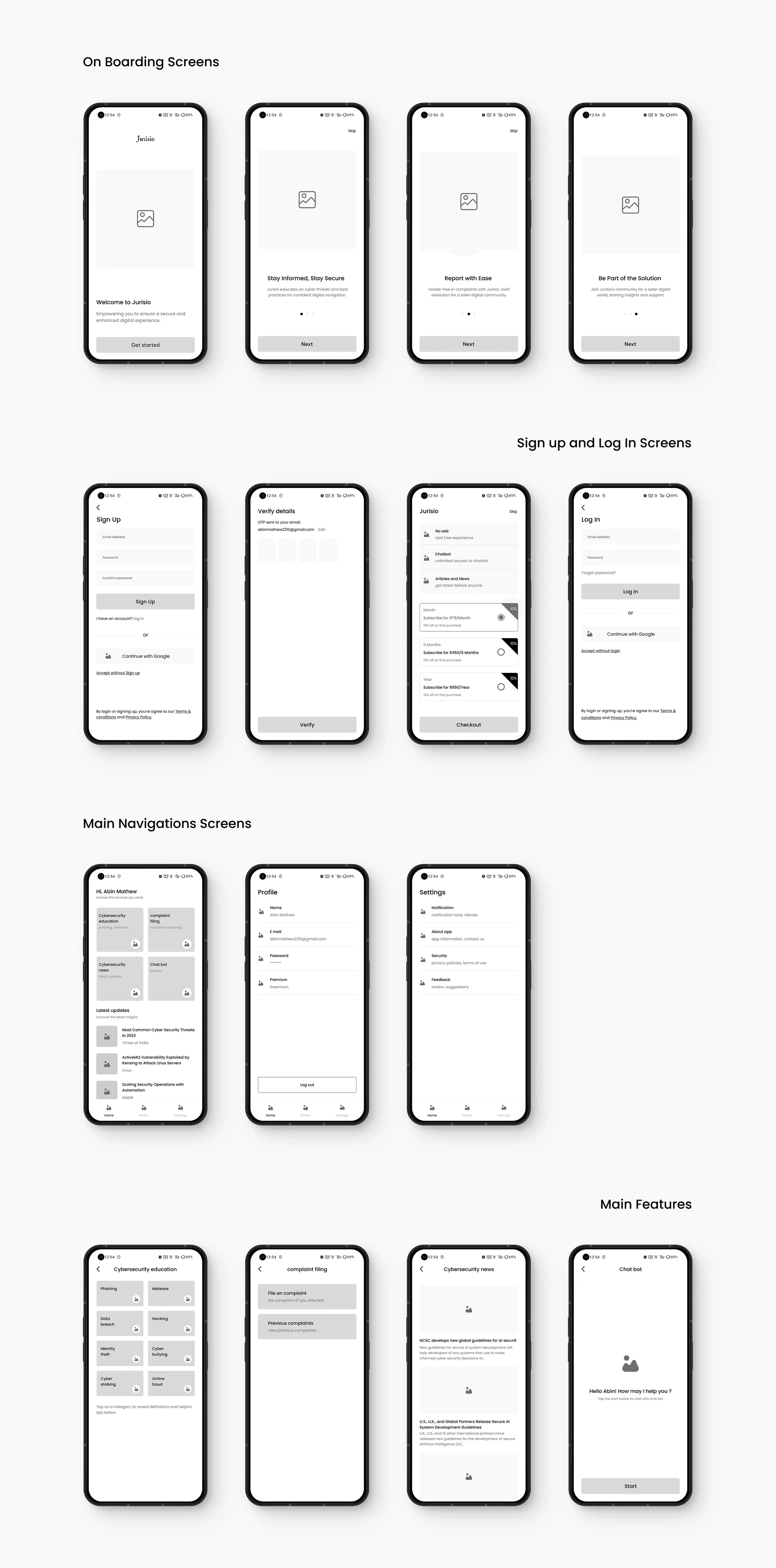
I wireframed onboarding, sign up and log in, navigation and the core features to check the flow before any visual design.
Greyscale wireframes08 · The final UI
Here's where it landed.
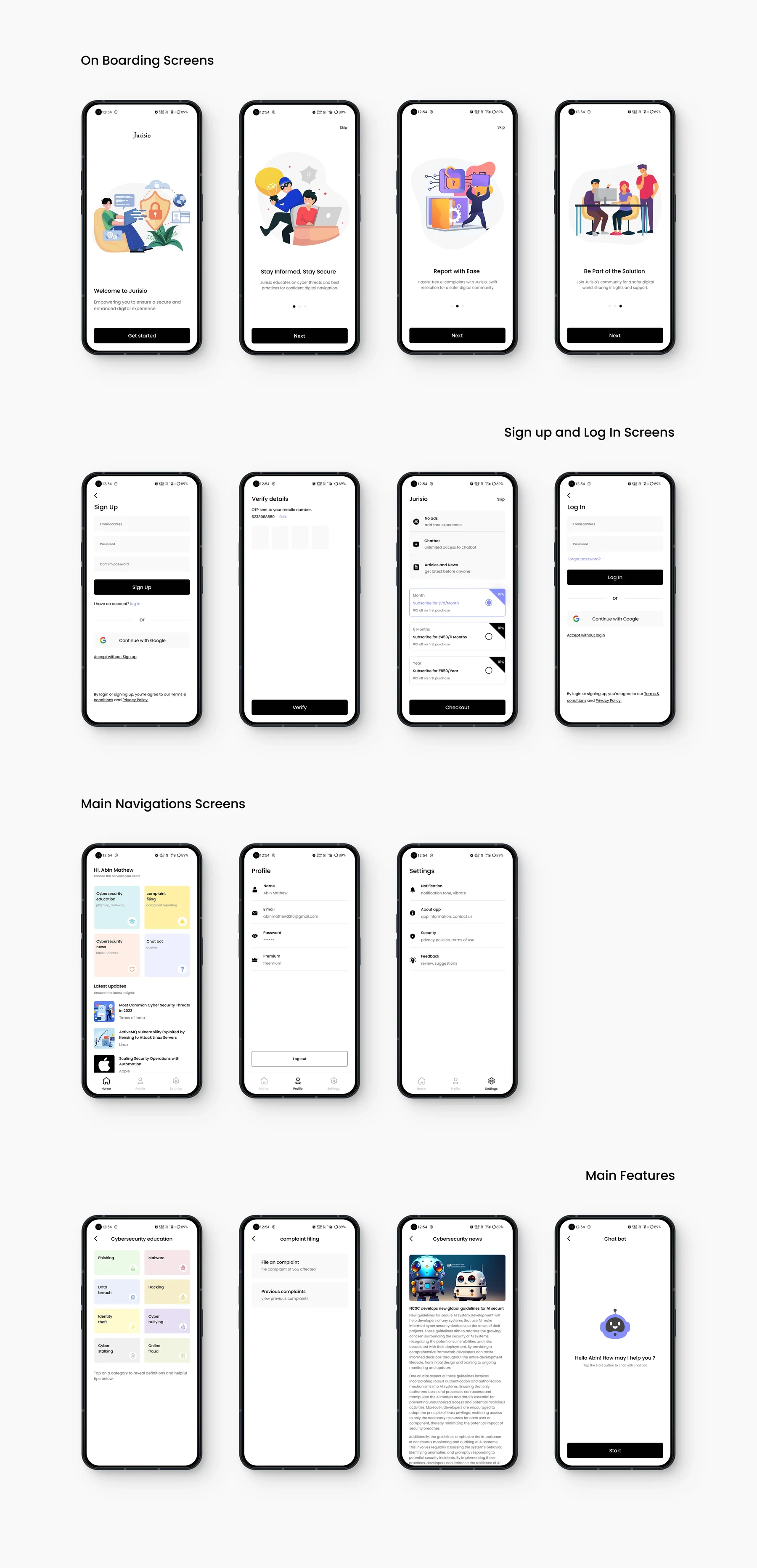
Friendly illustrations and soft colour-coded cards make cybersecurity feel approachable instead of intimidating.
Onboarding & sign up
Four illustrated screens: stay informed, report with ease, be part of the solution. Then sign up, OTP and log in, with an option to continue without an account.
Main features
Home gives quick access to education, complaint filing, news and a chatbot. Education is split into topics like phishing, malware, hacking and online fraud.
09 · What happens next
Next up: proving it works.
Jurisio is a concept. If it launched, these are the signals I'd watch first.
How many people finish an incident report once they start one
Time from opening the app to a submitted report
Learning path completion and return visits
How many people turn on local threat alerts
The takeaway
I started with people who felt unsafe online and didn't know what to do. I wanted an app that makes them feel informed, and heard.
Learning paths meet people at their own level.
A short report form with tracking makes reporting worth doing.
Live alerts and news bring scattered information into one place.
Illustrations and plain language take the fear out of the topic.
Research with real people changed the tone of the whole product: from a technical tool to something friendly enough that anyone would open it.